By Lynn Burnett
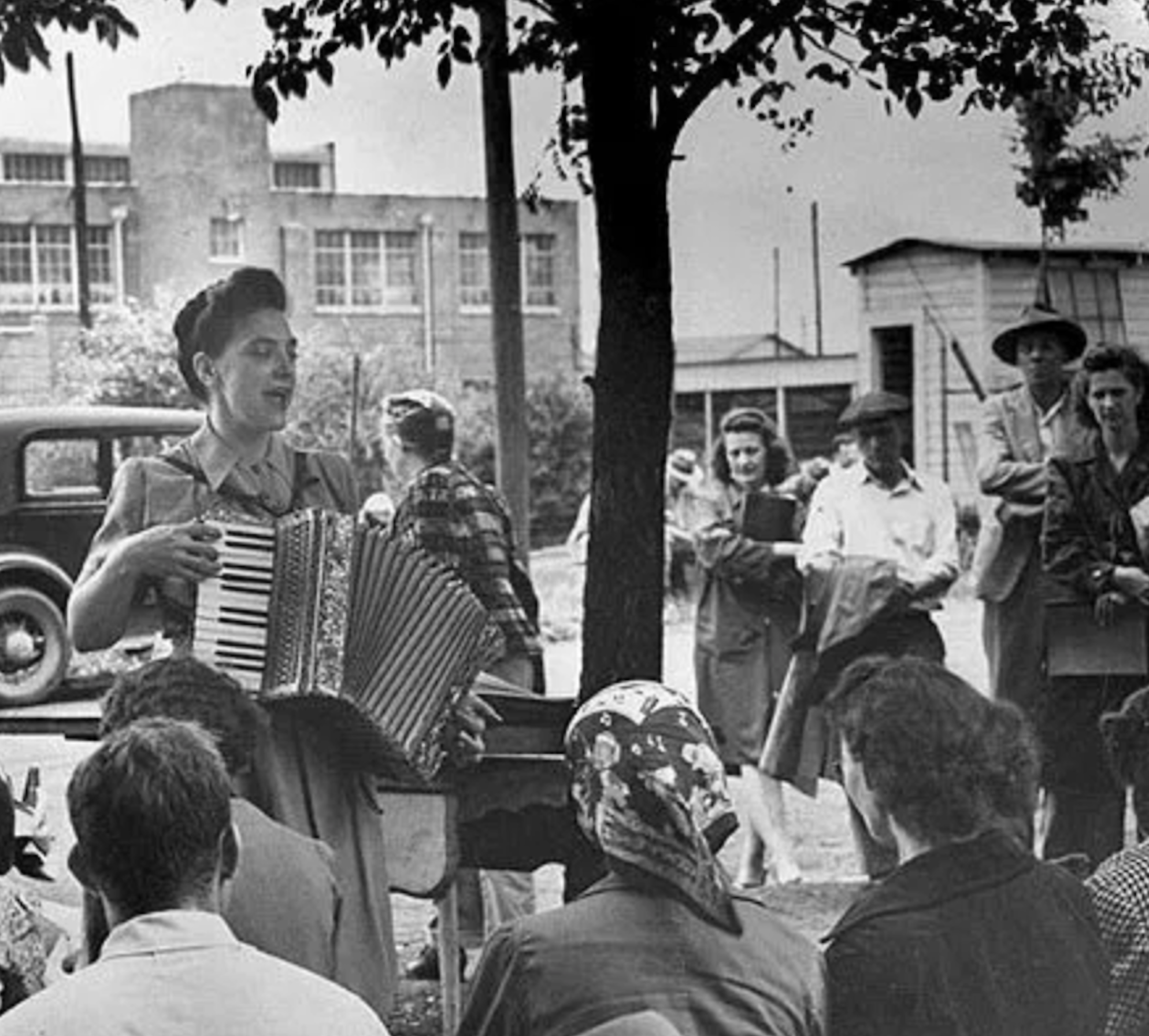
This story is part of the White Antiracist Ancestry Project. The image is of Zilphia Horton, leading strikers in song on a picket line in the 1930s.
“Music is the heart of things – of beliefs, situations, of struggle, of ideas, of life itself.”
Zilphia Horton
“A singing army is a winning army and a singing labor movement cannot be defeated. Songs can express sorrow as well as triumph, but the fact that a man sings, shows that his spirit is still free and searching, and such a spirit will not submit to servitude.”
United Mine Workers President John L. Lewis, writing about Highlander
Zilphia Horton was known as “the heart” of one of the most important training grounds for the labor and civil rights movements: the Highlander Folk School. Founded in 1932 and located in the Appalachian Mountains of Tennessee, Highlander was a radical, racially integrated community in the Jim Crow South. Zilphia was the force behind much of the liberatory culture of Highlander… the culture that, in many ways, allowed it to succeed. As Highlander scholar Stephen Preskill puts it, “Without her, Highlander might have failed.”
Zilphia used music and theatre to build community at Highlander, to bring out the best ideas of the organizers who gathered there, and to test those ideas. She nurtured Highlander’s atmosphere of hospitality and solidarity, where creativity and connection flourished. It was in the atmosphere that she crafted as Highlander’s culture director that history was made.
Youth
Zilphia Mae Johnson was born on April 14, 1910, in rural Arkansas. Her mother, Ora, came from a family of farmers, and her father, Gus, was a coal miner. Her father’s job was to crawl through the mine shafts with a candle attached to a long pole, burning out pockets of methane gas that could asphyxiate miners. It was the most dangerous job in an already dangerous profession.
Although Zilphia’s family was poor, they were self-sufficient and resilient. Her mother was an expert craftswoman, who was capable of sewing an outfit simply by looking at a picture. Her father was a skilled marksman and hunter, who knew how to keep his family fed even in tough times. She and her sisters learned how to hunt, fish, grow food, and forage. Zilphia became an expert markswoman herself. She was also capable of fixing just about anything.
Zilphia’s family moved continuously from mining camp to mining camp, often living in tents. However, in order to attend school, Zilphia spent much of her childhood living with her grandmother. Grandmother Howard created a warm space, where music played, and the home smelled of good cooking. As Zilphia’s biographer Kim Ruehl writes, “So much of the hostess she became, the radical caretaker whose presence was vital to the well-being of Highlander staff and students, can be traced back to her grandmother’s kitchen.” It was also at her grandmother’s house where Zilphia fell in love with the piano, and where she grew into an excellent musician.
By the time Zilphia was in high school, her father had worked his way up from the lowest job in the mining industry to becoming a mine manager. It was a well-paying job that allowed the family to build a nice home. With the days of moving from mine camp to mine camp behind them, Zilphia went to live with her parents in the small mountain town of Paris, Arkansas.
Her address was 1816 Klan Road, just down the street from the local klavern. A ledge wrapped around the meeting place for the local Ku Klux Klan, and Zilphia and her sisters enjoyed walking it like a balance beam. She would sometimes sneak into the klavern to play the piano. In this small town, the Klan was not some secretive organization. Indeed, it was a central part of the town’s social life. Zilphia’s mother may have even sown their robes.
Zilphia’s strongest memories of power and injustice, however, involved labor disputes. She vividly recalled a strike, during which Mexican labor was brought in to replace the strikers. Her father, no longer the miner but the mine manager, began pacing around the house at night, looking out the window with a pistol in hand. Cars would pull up at the edge of the woods in the night: miners who had always been kind to Zilphia, but who now saw her father as their enemy. She knew their hardships, which had once been her father’s, and she wanted better for them.
Finding Her Path
After graduating from high school in 1928, Zilphia attended the University of the Ozarks, where she trained in classical piano. Her curiosity was insatiable. She studied the lives of the composers she loved, and was especially interested in their ideas about the role of art in society and the responsibility of the artist.
The study of classical music also deepened her appreciation of folk music, which soon became a central force in her life. As Zilphia later wrote:
“Why have composers such as Bach and Liszt spent months and years collecting folk tunes which they later used in their great compositions? The folk song grows out of reality – out of the everyday lives and experiences of people. It is this stark reality and genuineness which gives the folk song vitality and strength . . . Where can more be found to sing about than in the joys and sufferings of people in their struggles for existence?”
After graduating in 1933, Zilphia returned home to Paris. At age 23, most of her friends had already married, but Zilphia had no interest in settling down and starting a family. She was adventurous and restless; interested in men, but not looking for a husband. Rather, she enjoyed shooting guns with men, smoking and drinking with them, and most importantly, seeking them out for stimulating intellectual conversation. All of this made her father concerned. He saw that Zilphia craved meaning and purpose, and suggested she attend a Bible study. It would change her life.
The Bible study was run by a Presbyterian minister named Claude Clossey Williams. As Kim Ruehl writes, Claude saw the Bible
“as a tale of economic strife, with marginalized and oppressed people as the ‘chosen.’ As he explained, those in positions of power . . . were always being shown the way by the fishermen, farmers, and penniless travelers of the Bible . . . Williams saw Jesus’s teachings of love as the only way forward . . . He believed civil equality was an innate right bestowed upon humanity by its creator.”
Claude’s theology led him to build bonds with the Black community on the other side of the Paris railroad tracks. He flouted Jim Crow norms by inviting Black folks into his home. He delivered antiracist sermons. He even organized integrated Bible studies for Black and White youth… the same Bible studies Zilphia was attending.
This radical minister made singing a central component of these integrated spaces. He revised traditional hymns to address racial disparities, as well as economic inequalities that young people of all races could relate to. Zilphia, who was already drawn to music as a force for social change, was enthralled. The Klan was infuriated. When Claude began traveling to the mine camps and preaching about the greediness of the mine owners and the need to organize, Zilphia’s father became infuriated too.
The Bible study had the opposite effect on Zilphia than her father had hoped. He worried that her adventurous and rebellious spirit – which now was extending into an interest in desegregation and labor organizing – was rubbing off on her sisters and hurting their marriage prospects. He told Zilphia she either had to change her behavior or leave. When she said she would leave, her father was stunned and tried to take it back. But Zilphia was ready for something bigger.
In figuring out her next steps, Zilphia turned to the one person she knew with ties to the world beyond rural Arkansas: Claude Williams. He urged her to visit Highlander, which was run by his friend… Myles Horton.
Highlander: Finding Love, and Home
The Highlander Folk School was named after the people living in the Appalachian Mountains where it was located, who at the time were commonly called highlanders. The school sought to create a space for common folk to come together, reflect on their shared problems, come up with their own solutions, and test them. Then they might come back to Highlander again, for further rounds of reflection and action.
The most common problems that people wanted to solve were poverty and labor exploitation. As an example, just months into its founding, Highlander had been on the front lines supporting local miners who had their food supply cut off by mine owners in retaliation for a strike. As babies starved to death, the mine company, which owned the miner’s homes, took the miner’s doors off in the dead of winter. They only succeeded in breaking the strike by assassinating the miner’s leader. For Zilphia – the daughter of a poor mine worker turned mine manager, and by then mine owner – these struggles hit close to home… and she was on the side of the miners.
When Zilphia arrived at Highlander in February 1935, it was for a six-week training in labor organizing. But then, she met Highlander founder Myles Horton. He had not only spearheaded the liberatory pedagogical vision of Highlander, but had displayed incredible bravery supporting the miners in their recent strike. Myles and Zilphia immediately fell for each other. They sensed that by being together, they would also strengthen their ability to pursue their work, their passions, and their visions. Instead of leaving Highlander after six weeks, Zilphia married Myles within three.
Myles knew that Highlander had some missing ingredients. He was an intellectual who had a deep understanding and vision for Highlander. He also understood that bringing people together to develop their own understandings, solutions, and action plans required more than just an intellectual understanding of how to do so. It also required crafting a space of hospitality, inspiration, and belonging. For Highlander’s pedagogy to function, it needed a proper container, where people could feel what they needed to feel, in order to understand what they needed to understand. A culture needed to be created in which Highlander’s pedagogy could take root. Myles saw, in Zilphia’s warm and creative spirit, someone who was far better equipped than he was to fulfill that essential mission. And so, he invited Zilphia to be Highlander’s culture director.
A Masterful Culture Crafter
Zilphia’s first act as culture director was creating a welcoming space for Highlander’s students, and developing a culture of neighborliness with the communities surrounding Highlander.
Many of Highlander’s neighbors had heard baseless rumors that the school was a training ground for “Godless Communists” – a condemnation that almost any organization confronting labor exploitation would have faced. These suspicions created a barrier between Highlander and the very people it hoped to serve. They also posed an obstacle to Highlander modelling the values it hoped to embody, and impacted the atmosphere within Highlander itself. Being a good neighbor was, in Zilphia’s view, a foundational element in building a liberatory culture at Highlander.
Zilphia understood singing and dancing to be one of the best ways to break down barriers. Unlike trying to understand one another by hashing out ideas or engaging in debate, these corporal and communal arts allowed people to simply enjoy one another’s common humanity. And that was a good starting point for letting go of unfounded fears and judgements.
Highlander already offered community nights with square dancing and live music, and some neighbors already attended. Zilphia proactively reached out to the surrounding community to let others know they were welcome as well. She also began digging into the musical traditions of the Highlander region, asking her neighbors what their favorite songs were, and learning them so that she could play the music that they knew and loved. By showing her neighbors that the Highlander community cared about their culture, Zilphia built bonds of trust and respect.
Song and dance also created a warm and welcoming environment for Highlander’s students. Students often arrived tired after their travels, and could feel out of place in a new environment. Singing and dancing lifted their energy, and helped people who were meeting each other for the first time to develop a sense of connection. Once people were energized and connected, they were better equipped to engage in the work they had come to Highlander to do. As historian Stephen Preskill writes, “Zilphia was convinced the informal singing and dancing that occurred just prior to the meeting primed everyone for more exuberant participation.”
Zilphia quickly discovered that creating a warm and welcoming environment also depended on accessibility. As Preskill notes, “she spurred the elitism that prompted many trained musicians to choose complex, hard-to-sing songs.” Instead, Zilphia removed all barriers to participation. She did away with sheet music, which the average person couldn’t read. She deemphasized her piano, and instead learned the traditional instruments of the region. And, she offered songs using melodies the participants would already be familiar with.
The musical program that Zilphia crafted was used to energize students, create a welcoming space, and help them connect with one another. This laid foundations for the music to then serve its pedagogical purpose: to support the students in working through the problems they most cared about. Here, relevance was key: while traditional music could energize people and bring them together, music was also needed that spoke directly to the needs of the people.
Over the course of a workshop, Zilphia would listen deeply to the experiences of the group, in order to bring forth the music that spoke to their experiences and their needs. She encouraged them to share – and to create – music that spoke to those experiences as well. Her technique was to first get a group energized and connected by singing traditional songs together. Once they had opened up, the group would be more receptive to going deeper. Then, Zilphia would introduce less familiar music, that spoke to the specific needs of the people.
As she had seen Claude Williams do, in order to bring across the needed message, Zilphia began a practice of rewriting traditional folk songs and church hymns that people were familiar with… using lyrics that offered fuel for their organizing. In engaging in these revisions, Zilphia was participating in a long lineage of poor and working-class people altering songs to make them meaningful to their current circumstances. As Zilphia’s friend Teffie put it, this practice allowed ordinary folks to use songs “effectively when it came to the need to carry new and strong messages to each other and to the outside world.”
Zilphia was also deeply committed to music as an empowering source of pleasure. While there was a pleasure people experienced in singing songs they all knew together, Zilphia was after, in Stephen Preskill’s words, “the deeper enjoyment that comes from collaborating with others on something larger than oneself.” She was after the deeper pleasures of belonging, purpose, and a sense of agency.
Theater as Practice and Preparation
In November of 1935, Zilphia traveled to New York City to attend the New Theatre School, where she hoped to expand her repertoire as Highlander’s culture director. There, she studied how to use theatre to explore social issues. When she returned in February of 1936, she shifted Highlander’s dramatics program “away from educating those who observed the plays to educating those who participated in them,” to use the words of Highlander historian John Glen.
Under Zilphia Horton’s direction, theater at Highlander became a vehicle for role-playing different scenarios that might come up during a strike, boycott, or other efforts the students at Highlander might be planning or engaged in. Those who congregated at Highlander might be able to practice, through theater, what they’d like to say to a boss… and through that practice, gain more courage to go back home and raise their voice.
In such a roleplay, another student might play the boss, allowing them to step into the shoes of the person in power. In planning any effective action, it was critical to understand the perspective of those with power, and how they might respond to different demands or actions. Under Zilphia’s direction, theater became a way for workers to look at situations from different angles, to envision new possibilities, test new ideas, and gain practice for real-world scenarios. The audience played a crucial role as well, sharing what they noticed, and then trying out new roleplays based on their observations.
In creating these roleplays, Zilphia wrote that “Students should be faced with the same conditions at the school as they would be in their home situations.” According to Stephen Preskill,
“Zilphia developed two simple criteria for evaluating the drama classes. Activities had to be practical enough to ‘take back to their home organizations and put into use,’ and they needed to challenge conventional thinking by putting learners in situations that introduced dilemmas or complexities that confounded what many thought they already knew.”
As with Zilphia’s approach to songs, accessibility was central to her theatre program. Over time, the program became ever more organic, moving away from scripts and written lines, and towards more improvisation and authenticity. The roleplays that were most successful at portraying important lessons and scenarios were printed and shared with organizers.
The Song Collector
In 1936, Zilphia briefly returned to Arkansas to take graduate classes in voice at the College of the Ozarks. She also immersed herself in learning about the musical history and traditions of the poor and working-class people of the region. During this time, she began writing to musicians and scholars, in what became a lifelong project of collecting songs. Her intention, in Kim Ruehl’s words, was to create a song collection that could “amplify the dignity of working people throughout the region by reintroducing them to their own culture.” Funding for the project, however, was hard to come by, and the project fizzled.
Then, in 1938, the Congress of Industrial Organizations (CIO) launched a $2 million dollar initiative to organize unions in the South. The CIO hired Highlander to train their labor organizers… and provided Zilphia with funding to create an official songbook. The backing of the CIO allowed Zilphia to spend more time on her song collecting efforts. This included extensive outreach, through which Zilphia established ties with folklorists and musicians around the country. Soon, even Woody Guthrie and Pete Seeger were sending her music for the songbook… and visiting her at Highlander, where they came away more inspired than ever to craft music for and about the workers of the world.
In creating her songbook, Zilphia was especially inspired by the example of Joe Hill’s 1909 The Little Red Songbook. Joe had been a member of the Wobblies, a radical union which welcomed all people into its ranks regardless of race or gender. In collecting and composing his songs, Joe embodied the lineage Zilphia was participating in. Like her – and like her first example, Claude Williams – he would often rewrite old church hymns the workers were already familiar with, with words that represented the values and goals of the labor movement.
Wobblies carried The Little Red Songbook into their worksites and out onto their picket lines. For them, music was a weapon in the war against exploitation. In his final words to his fellow workers, shortly before his execution by firing squad in 1915, Joe Hill wrote: “Don’t mourn, organize!” The words became a rallying cry for generations of organizers.
As Zilphia crafted her book, she added notes about the history of the songs, the conditions under which they were written, and the impact they had. This allowed workers using the book to feel that when they sang these songs, they were participating in a historical legacy. By offering labor songs from many regions, Zilphia also helped workers, who were often focused on their own local circumstances, to see that they were not alone, but were part of a larger movement. This provided courage and inspiration… and those were fuel for action.
Zilphia’s book was simply titled Labor Songs. Published in 1939, in its introduction, United Mine Workers president John L. Lewis described Highlander as “A singing army.” He continued:
“A singing army is a winning army and a singing labor movement cannot be defeated. Songs can express sorrow as well as triumph, but the fact that a man sings, shows that his spirit is still free and searching, and such a spirit will not submit to servitude.”
The Unity of Economic and Racial Justice
As Zilphia Horton shaped Highlander’s cultural programs, Highlander was becoming increasingly committed to fighting racial oppression in the South. Myles Horton had always opposed Jim Crow, viewing it as both a system of racial terror, and of economic exploitation. He had long viewed Jim Crow as benefiting the rich and powerful, by preventing Black and White poor and working-class people from organizing together for fair wages and working conditions. Zilphia shared this understanding. Together, they were committed to making Highlander a space that could bring people together across the lines of racial division.
Although located in the Jim Crow South where interracial gatherings were dangerous, Highlander had been open to Black participants since its founding in 1932. Its first large integrated gathering took place in 1935, shortly after Zilphia arrived. At that gathering, the All-Southern Civil and Trade Union Rights Conference had quickly relocated to Highlander after armed White supremacists had shown up to their original location with sticks of dynamite. The meeting tackled a range of racial justice issues, including supporting the Scottsboro Boys and outlawing lynchings.
In 1940, Highlander issued an official non-discrimination policy. Although these practices had been in place for years, Myles felt it was important that they were clearly stated, and that anyone considering coming to Highlander be made aware of them. Highlander let it be known that “unions should notify in advance all students both white and Negro that there would be no discrimination” during their stay at Highlander. During this same period, Myles and Zilphia deepened their ties with Black sharecroppers through the Southern Farmers Union. They viewed this connection, in Kim Ruehl’s words, as “another way to connect poor whites with poor Blacks, and to do so through something as vital as the Southern food supply.”
By the late 1940s, the students who showed up at Highlander were increasingly diverse. When they arrived, they found integrated bunk rooms, bathrooms, and dining tables. Myles was often asked how integration was achieved at Highlander, and was fond of saying: “First, the food is prepared. Second, it’s put on the table. Third, we ring the bell.” In saying this, Myles was using his famous sense of humor to put people at ease… which itself contributed to making integration possible at Highlander. The joke was also his way of pointing out the absurdity of segregation: why should such a simple thing be so hard?
In reality, however, what allowed for racial integration at Highlander required nuance and skill. Students – both Black and White – who had been raised under Jim Crow felt an understandable unease arriving in the desegregated community of Highlander, although only Black attendees faced a true risk. As Kim Ruehl puts it, “The white folks had to submit to coming down from their imagined pedestal while the Black folks had to trust they wouldn’t be harmed in their sleep.” The culture that Zilphia crafted at Highlander was critical for creating a sense of safety for Black students. Without that culture, Highlander’s commitment to integration would have existed in name only. It was the culture that allowed the commitment to become real.
As Highlander grew into a more diverse community, music became an even more important tool for building solidarity and belonging. In Zilphia’s words:
“Groups of varied cultural backgrounds can sing together and achieve a unity often not otherwise possible. The strong emotional element in music has a power to bring people together. Because people can sing what they would never speak, music will often unify groups that would be divided in discussion.”
“We’ll Be Alright”
Zilphia worked hard to embody the songs she taught, singing them over and over again until they seeped into her bones, and experimenting with them until they became her own. Kim Ruehl describes her sense of responsibility around this process:
“Zilphia knew that whether the students were affected by a song would be determined by the way she sang it for them that one time. She was determined to place it in her muscle memory so that it might travel into theirs.”
As Highlander deepened its ties with Black workers throughout the 1940s, more of the music that Zilphia learned came from Black communities. Zilphia felt a special sense of responsibility when it came to how she sang music that was deeply rooted in the Black experience, including in forms of oppression that made the experiences of poor White miners pale in comparison. Kim Ruehl, once again, describes Zilphia’s approach beautifully. Her words are worth quoting at length. Zilphia
“knew that the way she learned to sing as a white woman taking lessons and studying music in college was markedly different from the way Black women sang in church. She wanted to sing this song the way they did – not to appropriate their musical attack, but to honor it, so that anyone listening might know that it was more than just a song, that it had come from a culture that demanded understanding and respect. She wasn’t using it for her own benefit, but rather acting as a conduit between the culture from which the song came and her audience, so that their view of the world might expand . . .
“The labor movement was, to her, an avenue towards empowering those people – Black and white workers alike . . . The work she was doing was a continuation of the movement for justice and equality that had been central to America from its founding and that had taken so many turns, including revolution, slave rebellion, and labor organizing. So rather than appropriate the culture of Black abolitionists, Zilphia wanted to join her students to their legacy, to link the plight of struggling workers to the plight of every single one of ‘those who loved and fought before.’”
Kim’s reference to ‘those who loved and fought before’ comes from the song No More Mourning, which Zilphia held especially close to her heart. She learned the song from a Black sharecropper named John Handcox, who Zilphia described as “a natural song-maker [who] used songs to help organize the Southern Tenant Farmers.” Kim Ruehl writes that Zilphia was deeply drawn to the song’s “optimism, determination, the way it colored the universal human impulse toward hope”:
No more mournin’
No more mournin’
No more mournin’ after while
Before I’ll be a slave
I’ll be buried in my grave
Take my place with those who loved and fought before.
Although Harry Belafonte would later make a popular recording of this song in the 1950s, and although Joan Baez would later sing it on the steps of the US Capitol the same day Martin Luther King gave his “I Have a Dream” speech, No More Mourning was not the most influential Black Freedom Struggle song Zilphia helped to popularize at Highlander.
The story of that song began on October 22, 1945, when the employees at the American Tobacco plant in Charleston went on strike. The strikers were Black women who were paid a mere ten cents an hour… the equivalent of a dollar-fifty today. After working grueling hours, these women could afford little more than enough bread to survive. Legally, they were owed a minimum of forty cents an hour, but the bosses ignored the law. They assumed that poor Black women wouldn’t dare challenge powerful White men. They were wrong.
From October until March, from before the sun rose until after darkness fell, these women held the picket line. They held the line through the winter and through the rains. They held the line through exhaustion, hunger, and cold, warming their hands over fires burning in metal drums. During these hard times, sources were needed to keep their spirits alive for the struggle.
At the end of those long days on the picket line, a young strike leader named Lucille Simmons led them in song. Lucille was a member of her church choir. The melody of the song she sang was ancient: it can be traced back to a Catholic hymn from the Middle Ages, Oh Santissima. Over many centuries, and countless lyrical incarnations, Oh Santissima found its way into Black spirituals. It eventually found its way to a Black woman born into an Alabama sharecropping family named Louise Shropshire, who offered her own version under the title If My Jesus Wills. It was likely this version that Lucille Simmons taught the striking women. Kim Ruehl describes her song as “long, slow, and haunting, like a meditation, an old, old hymn with new words:”
We’ll be alright
We’ll be alright
We’ll be alright someday.
Down in my heart
I do believe
We’ll overcome someday.
As the strikers sang this ancient hymn that had gone through so many incarnations, they added their own words that spoke to their struggle: I’ll be alright . . . We will win our rights . . . We will win this fight . . . We will overcome! The song offered spiritual fuel that kept these women going.
Although the strike ultimately failed, the women who participated were forever changed. Some took their newfound experience with organizing into other labor struggles, and eventually, became deeply involved in the Civil Rights Movement. In 1946, the summer after the strike ended, a small group of these women attended a workshop at Highlander. Unfortunately, the names of these women are unknown. But by transmitting this song to Zilphia Horton, they left their mark on history.
As Kim Ruehl writes,
“Zilphia knew an important song when she heard it. She adopted ‘We Will Overcome’ as a sort or personal anthem, printing it on song sheet broadsides. From that moment on, she taught it to everyone who came through Highlander. She closed every meeting with it. She sang it as a sort of closing prayer at every event and gathering when a song seemed necessary. The song struck a perfect balance between public declaration and personal meditation. It was a reminder to all those listening of the persistence of the human spirit.”
In the fall of 1948, Zilphia sat alone with the folk music legend Pete Seeger, teaching him the song. He was so moved that he made We Will Overcome a part of his musical repertoire. Guy Carawan, who would become Highlander culture director following Zilphia’s death, adopted the song as well. As a performer, Guy decided to shift the rhythm of the song, so that it felt more like a march. Pete Seeger adopted the new rhythm… and changed the “we” to “shall.”
In this way, perhaps the most important incarnation of Oh Santissima was born: We Shall Overcome.
Roots of the Citizenship Schools
In 1953, as the Brown vs. Board case wound its way through the courts, the staff at Highlander sensed that a major blow to Jim Crow was on the horizon. If the Supreme Court ruled that segregated schooling was unconstitutional, there would be enormous ripple effects. Such a ruling could open the door to challenging segregation in other institutions… and perhaps to challenging Jim Crow itself. At a staff meeting, the Highlander community decided to pivot the school’s energies to more fully support the growing struggle against Jim Crow.
And so, in 1953, Highlander hosted a workshop on how to respond if the Supreme Court ruled that segregated schooling was illegal. The White South would not give up easily, and organizing would be necessary to make the new laws a reality. When the Brown decision did indeed outlaw segregated schools in May of 1954, Highlander hosted another workshop on how to capitalize on that decision.
In attendance was a brilliant Black educator named Septima Clark. Septima was a seasoned teacher, and a movement veteran. She was deeply moved by the liberatory culture and pedagogy she encountered at Highlander, as well by the experience of integration at the school… an experience she had never imagined could be made to feel so normal. After Septima returned to Highlander for subsequent workshops in the summer of 1954, she was hired to lead the school’s civil rights education efforts.
As part of those efforts, Septima connected Highlander to a former student of hers named Esau Jenkins, who was committed to supporting Black voting rights. At the time, Black southerners often needed to pass literacy tests to register to vote. Since illiteracy was widespread, Esau hoped to establish literacy schools to support voting rights efforts. He and Septima believed Highlander could help.
For Highlander, this presented an opportunity to build a connection with a Black community that was ready to move. But Esau’s community – the Gullah people of the South Carolina Sea Islands – were guarded against outsiders, especially if they were White. Highlander would have to prove itself to the community.
Septima believed Zilphia was the right person for the job. And so, Zilphia traveled to the Sea Islands. “She came,” Kim Ruehl writes,” with her songs and her instruments to lay a foundation for what, she had a strong inkling, would be a long and productive relationship.” Indeed, the community warmed to her, partly because Esau vouched for her so strongly, but also because of Zilphia’s clear love for the music that had arisen from the Black experience, and her ability to sing it with such understanding and authenticity.
This was the beginning of trust being built… and the beginning of a long collaboration with Highlander. The efforts of Esau Jenkins and Septima Clark, backed by Highlander, soon led to the establishment of the first citizenship schools of the Civil Rights Movement. When the literacy programs of those first schools helped every single one of their students – taught by Septima Clark’s cousin, Bernice Robinson – gain the right to vote, Highlander helped launch dozens of other citizenship schools.
Rosa Parks Comes to Highlander
Although the Brown decision struck the first major blow to Jim Crow in 1954, as 1955 came to a close, there was still no hoped-for mass movement. That would change on December 1, 1955, when Rosa Parks refused to give up her seat on a segregated bus in Montgomery.
By 1955, Rosa was an experienced freedom fighter. In the 1930s, she and her husband Raymond hosted armed, late-night meetings in their home to support the Scottsboro Boys. During the 1940s, she was a lead investigator of racial assaults in Alabama. Rosa was especially focused on the widespread rape of Black women by White men, which almost always went unpunished. She risked her life journeying down the isolated, dusty roads of rural Alabama, interviewing survivors. She even spearheaded a national campaign to shed light on the sexual violence Black women faced.
Rosa also loved mentoring youth, and ran the NAACP Youth Council in Montgomery. These young people, supported by their mentor, challenged Jim Crow laws in Montgomery, drinking at Whites-only water fountains, holding demonstrations protesting segregated libraries… and sometimes refusing to move from their seats on the buses. These youth inspired and energized Rosa Parks.
However, as Stephen Preskill writes, Rosa “felt deeply discouraged and suffered from physical and psychological exhaustion.” She worried that “most black adults in Montgomery were so beaten down by white supremacy and the relentless terrorism of the Ku Klux Klan that they had little faith in the possibility for change.” Two of her dearest friends in Montgomery, the local NAACP president E.D. Nixon and a White civil rights activist Virginia Durr, believed that some time at Highlander would reenergize Rosa Parks.
And so, with the support of her friends, Rosa Parks arrived at Highlander for a two-week intensive training… just four months before she refused to give up her seat. The training was titled Racial Desegregation: Implementing the Supreme Court Decision. Its goal was to support students in developing their own plans to desegregate their communities. It tackled some of the very issues that had been troubling Rosa, including divisions in Black communities, how to overcome them, and how to build unity around a common cause.
Although Rosa Parks had thought deeply about these topics for many years, being in the atmosphere of Highlander – that atmosphere that Zilphia Horton had done so much to create – gave her a much-needed jolt of energy and inspiration. She later wrote, “I found for the first time in my adult life that this could be a unified society, that there was such a thing as people of all races and backgrounds meeting and having workshops and living together in peace and harmony.” She described the experience as life changing.
Having such a positive experience at Highlander also made it harder for Rosa to return to the daily humiliations of Jim Crow that she experienced in Montgomery. Her friend Virginia Durr wrote to Myles and Zilphia: “When she came back she was so happy and felt so liberated and then as time went on, she said the discrimination got worse and worse to bear AFTER having, for the first time in her life, been free of it at Highlander.”
Given Rosa Parks’ long history of activism, she may well have refused to give up her seat on that bus whether she had gone to Highlander or not. In fact, she had long been determined not to move if such a moment came. She was already encouraging the Black youth she mentored to not to give up their seats. One of those youths, Claudette Colvin, had already been arrested for refusing to move from her seat, months before Rosa went to Highlander. Indeed, ever since the Brown decision had outlawed segregated schools, Rosa and her colleagues in Montgomery had been planning ways to take on the segregated transportation system.
Ultimately, whether or not Rosa would or would not have moved from her seat without her time at Highlander is not the point. The story of Rosa Parks at Highlander points to the reality that organizers can suffer from emotional and physical exhaustion, and that they need sources of energy and inspiration to stay in the struggle. The potential Rosa Parks of this world need periods of retreat and of reflection. They need connection and community. All of that facilitates the energy and courage to take whatever stand the moment calls for. And all of that is nourished and supported by crafting culture.
An Unfinished Journey
Throughout these history-making moments at Highlander, Zilphia’s personal life continued to evolve. On February 22, 1943, she had given birth to her first child, Thorsten Wayne Horton. On March 24, 1945, she gave birth to Charis (pronounced “Karis”) Ermon Horton. The children grew up being held by friends, by as their mother led the community in song.
When Charis was diagnosed with polio at age four, and later suffered from severe burns when her dress caught on fire at age six, Zilphia came up with all manner of fun projects, from creating puppet theatres to crafting unique Christmas decorations. Zilphia adored being a mother, and she was just as creative in her parenting as she was in the rest of her life. Despite other hardships, including the targeting of Highlander by White supremacists and the FBI, the children thrived.
Zilphia had an insatiable curiosity and a lust for life, and over the years had spent time in big cities like New York and Chicago, taking classes to expand her abilities as a cultural organizer, and enjoying the larger worlds of art, music, and theatre that big cities offered. She and Myles had traveled to Mexico and Guatemala, where she thrived amongst different cultures, and developed an increasing interest in international human rights and organizing across national boundaries.
Zilphia loved the opportunities that big cities and international travel held, and sometimes felt stifled at Highlander. At times, she felt a tension between her responsibilities at Highlander, and her desires for broader experiences and for self-actualization. When she felt this way, she often turned to nature. Although Zilphia did not embrace any specific religious tradition, she was a spiritual person, and nature offered her clarity, reflection, and healing. Nature was also a source that nourished her as an artist. As Kim Ruehl writes, Zilphia
“found hope and some indication of a way forward when she paid close attention to details: the tiny bird chattering, the wind-blown hemlock. As she watched people interact and considered the broader context of the times, she knew that focusing on the little things would help inform her on how to move culture through the arts.”
On April 1, 1956, Zilphia was working in her office. Questions about her direction in life swirled together with excitement about the growing Civil Rights Movement. She reached for a Mason jar and took a quick swig of what she thought was homemade moonshine. Instead, it was carbon tetrachloride… the chemical Zilphia used to clean her typewriter. She ran to the bathroom, stuck her fingers down her throat, and vomited up as much of the poisonous liquid as she could. But it was too late.
Zilphia Horton died of kidney failure on April 11, 1956, just three days before her forty-sixth birthday. In one of her last conversations with Myles, she expressed immense gratitude for her life and everything they had made together. And she expressed immense regret, that she would not see her children grow up. She told the children that she wanted them to be completely, authentically themselves: for “Charis to be Charis, and Thorsten to be Thorsten.” Zilphia was calm as she died, and she was focused on love.
Seeds Flower
Zilphia had lived just long enough to see the opening salvo of the Civil Rights Movement: the Montgomery bus boycott. Five years later, when student-led sit-ins swept the South in 1960, the movement that began in a single city finally grew into the regionwide, mass movement that Zilphia would have hoped for. The students who led the sit-ins soon founded the Student Nonviolent Coordinating Committee (SNCC), which did much of the best grassroots organizing of the movement. They trained for their nonviolent resistance campaigns using roleplays that were strikingly similar to those Zilphia had led at Highlander.
In 1960, Guy Carawan, who had inherited Zilphia’s role as culture director at Highlander, taught SNCC leaders the song We Shall Overcome. The students, Kim Ruehl writes, “instinctively, unprompted, linked arms and swayed as they sang.” Through them, the song grew into the unofficial anthem of the Civil Rights Movement. Freedom Singer Bernice Johnson Reagon later commented that first Zilphia, and then Pete Seeger and Guy Carawan, had served as White “custodians” of the Black spiritual. “They had kept it alive by singing it as a song of struggle but were proud to see it reclaimed by Black people. And reclaimed it was.”
Meanwhile, the citizenship schools continued to spread as the Civil Rights Movement picked up steam. Myles Horton realized that a larger organization, with greater capacity, would be better equipped to take them on. In 1961, Septima Clark convinced Martin Luther King to adopt the program through his organization, the Southern Christian Leadership Conference (SCLC). The SCLC’s Citizenship Education Project eventually trained 3,500 citizenship school teachers, who helped 125,000 Black Southerners gain their right to vote.
Highlander had always had an analysis that racial division was a tool, wielded by the powerful, to divide ordinary working people. Martin Luther King’s last campaign – the Poor People’s Campaign – embodied this analysis, by seeking to build a multiracial movement against poverty. When the assassin’s bullet ended Martin’s life, he was forging relationships with Indigenous, Latino, and poor-White Appalachian leadership… the latter, who were also known as highlanders.