Cross Cultural Solidarity

History in the Service of Solidarity

Resources for Activists & Organizers

Find Protests, Boycotts, & other Resistance-Related Events.

Protest Rights & Safety Tips.

Join an Organization.

Mutual Aid.

Immigrant Rights Resources.

Books For Activists and Organizers.

Books for Saving Democracy.

Cultivating Hope.

Narrative Strategy.

Nonviolent Resistance.

Suggested Sources for News & Analyses.

Join an Organization

Image: From Indivisible.org

One of the best ways to contribute to positive change is to join an organization. It’s a great way to build community, stay inspired and plugged in, and learn, grow, and become more effective. There are thousands of great organizations doing justice work: here are some suggested starting points. Many of these orgs also have local chapters that can help you explore your local movement ecosystem, where you can find a range of local organizations best suited for you.

For a more comprehensive source, see this list of “500 Leading Progressive Organizations.” If you’re looking for organizations primarily doing get out the vote work, see this special get out the vote resource.

350: We believe in the collective power of ordinary people taking action: we campaign and organize locally and globally to create a world powered by just and accessible renewable energy that will move us away from fossil fuels.

50501: Building momentum through community-building and protests: 50501 is a grassroots political organization protesting the second Trump administration.

Color of Change: Color of Change leads campaigns that build real power for Black communities. We challenge injustice, hold corporate and political leaders accountable, commission game-changing research on systems of inequality, and advance solutions for racial justice that can transform our world.

Federal Unionists Network: An informal association of federal unionists and our allies organizing to support each other in strengthening our unions, improving our agencies and building solidarity across the federal sector of the labor movement.

Indivisible: A grassroots movement of thousands of local groups with a mission to elect progressive leaders, rebuild our democracy, and defeat the Trump agenda.

Mijente: We are a political home for Latinx and Chicanx people who seek racial, economic, gender and climate justice.

Showing Up For Racial Justice (SURJ): Mobilizing white people for justice across the country. Through campaigns, education, and action opportunities, SURJ moves people to reject racism and complicity– and to join movements for change.

Sunrise Movement: We’re a movement of young people fighting to stop the climate crisis and win a green new deal.

Third Act: Organizing elders to protect the climate and strengthen our democracy.

United We Dream: As the largest immigrant youth-led network in the country, our members advocate for the dignity and respect of all immigrants.

Working Families Party: Building a multiracial party of working people to transform our country.

Suggested Sources for News & Analyses

Knowing where to turn for excellent news and analysis is always important… especially in turbulent times. Below are some great sources to explore.

Suggested Sources of Analyses for Activists & Organizers

Suggested Newsletters from Excellent Thinkers

Suggested Left & Progressive News Sources

Popular Magazines with Good Progressive Writing

Suggested Mainstream News Sources

Narrative Strategy  

Resources

ASO Communications: Applying tools from cognition and linguistics, we uncover where people are capable of going and how to use our words, images and stories to move them.

The Center for Story-Based Strategy: Center for Story-based Strategy cultivates imagination spaces where story, grassroots leadership, organizing, and democracy are interwoven strategies to build power.

Convergence Magazine: Article Collection on Narrative Strategy.

George Lakoff: Framing for Activists.

Scot Nakagawa: Stories of Resistance: Narrative Strategies for Democratic Movements.

Narrative Initiative: We collaborate with social movements to transform deeply held beliefs and values to make equity and justice the foundations of multiracial democracy.

Race-Class Academy: A 12-video introduction to how together we can beat dog whistle politics by building cross-racial and cross-class solidarity.

Reframing America: Reframing America is about questioning the assumptions in our public debate that restrict our thinking, and proposing new and better ways of talking about what’s happening in our country and in our lives.

Nayantara Sen: How the Light Gets In: Narrative Power Building through the Arts.

Words to Win by Podcast: Takes listeners on a journey around the globe with renowned communications researcher and campaign advisor Anat Shenker-Osorio as she unpacks real-world narrative shifts that led to real-world victories.

Books

Lee Anne Bell: Storytelling for Social Justice: Connecting Narrative and the Arts in Antiracist Teaching.

Doyle Canning & Patrick Reinsborough: Re:Imagining Change: How to Use Story-Based Strategy to Win Campaigns, Build Movements, and Change the World.

Micharl Jackson: The Politics of Storytelling: Variations on a Theme by Hannah Arendt.

Claire Keifer & Cliff Mayotte (editors): Say it Forward: A Guide to Social Justice Storytelling.

Sonali Kolhatkar: Rising Up: The Power of Narrative in Pursuing Racial Justice.

Ian Haney López: Merge Left: Fusing Race and Class, Winning Elections, and Saving America.

Nesrine Malik: We Need New Stories: The Myths that Subvert Freedom.

Annalee Newitz: Stories Are Weapons: Psychological Warfare and the American Mind.

Francesca Polletta: It Was Like a Fever: Storytelling in Protest and Politics.

Rebecca Solnit: Whose Story Is This?: Old Conflicts, New Chapters.

Books About Storytelling & Human Nature

Brian Boyd: On the Origin of Stories: Evolution, Cognition, and Fiction.

Jonathan Gottschall:

Will Storr: The Science of Storytelling: Why Stories Make Us Human and How to Tell Them Better.

Charting the Resistance to the Second Trump Administration

Image: from Hands Off! rally in San Francisco.

This page is part of a resource collection: Tracking this authoritarian moment, and the resistance to it.

Each of the pages below tracks a specific dimension of the resistance to the Trump administration, across a variety of tactics, institutions, and sectors of society. Most pages begin with a resource collection, followed by a news roundup. Collectively and at scale, these many forms of resistance undermine the pillars of support authoritarian regimes rely on.

Please share the Go Fund Me to for this project, so it can chart the Resistance for the entirety of this administration.

Artists.

Boycotts.

Celebrities.

Democratic Party.

Faith-Based.

Federal Workers.

Grassroots Organizing Against ICE.

Grassroots Organizing Against Trump.

International.

Legal.

MAGA.

Mass Protest.

Media.

Military & Defense Industry.

National Guard.

Scientific Community.

Sports.

Universities.

Veterans.

Workers.

Youth.

Further resources on charting the resistance.

Immigrant Rights Resources

Image: From the Leadership Conference on Civil & Human Rights.

The Fight Against ICE

Resources for the Fight Against ICE.

Know Your Rights

ACLU:Know Your Rights resources for immigrants.

Immigrant Legal Resource Center (ILRC): Red Cards/Know Your Rights Cards.

National Immigration Law Center: Know Your Rights Explainer.

Hotlines

National Network for Immigrant and Refugee Rights (NNIRR): List of immigration hotlines. (For reporting raids,seeking help if being detained or at risk of being deported, or reporting missing migrants.)

Mutual Aid

Image: from How a Year of Mutual Aid Fed Minneapolis.

Connie M. Razza: “…we define mutual aid as an all-encompassing term for projects that provide direct and collective aid to people as a form of solidarity, often with an expressly political framework and the goal of long-term social change.”

Resources

Stand With Minnesota: (This page is an incredible model for any area.)

Dean Spade: Resources from the author of “Mutual Aid: Building Solidarity During this Crisis (and the next.)

Mutual Aid Disaster Relief.

Mutual Aid Hub:

Buy Nothing.

Community fridges.

Little Free Pantry.

Articles for Building Mutual Aid Networks

American Friends Service Committee: How to create a mutual aid network. (Includes resource collection.)

The Black Panther Party: Service to the People Programs.

Future Currents: Building Power Through Mutual Aid: Lessons From the Field. (This is a significant, 58-page report on the state of mutual aid efforts in 2024. See the main takeaways from the report here.)

Mariame Kaba & Alexandria Ocasio-Cortez: Mutual Aid 101.

Scot Nakagawa: Mutual Aid: From Surviving to Thriving.

Barbara Rodriguez: ‘We have to keep showing up for each other’: In Minnesota, caregiving is a form of resistance.

Books

Dani Burlison & Margaret Elysia Garcia (editors): Red Flag Warning: Mutual Aid and Survival in California’s Fire Country.

Jimmy Dunson (editor): Building Power While the Lights are Out Disasters, Mutual Aid, and Dual Power.

Mariame Kaba & Kelly Hayes: Let This Radicalize You: Organizing and the Revolution of Reciprocal Care.

Jessica Gordon Nembhard: Collective Courage: A History of African American Cooperative Economic Thought and Practice.

Rebecca Solnit: Hope in the Dark: Untold Histories, Wild Possibilities.

Dean Spade: Mutual Aid: Building Solidarity During This Crisis.

Books about Community and Belonging

Image from the SNCC Legacy Project, of SNCC staff singing freedom songs. (Singing is a powerful way to build strong community bonds.) Atlanta, 1963.

Although these books are not directly about activism or organizing, effective activism and organizing rests on the strength of the bonds we build together. A strong sense of community and connection supports the energy and emotional health of organizers, prevents burnout, keeps people invested over the long haul, and contributes greatly to growth, meaningful learning, and effective action.

Fay Bound Alberti: A Biography of Loneliness: The History of an Emotion.

Peter Block: Community: The Structure of Belonging.

John T. Cacioppo & William Patrick: Loneliness: Human Nature and the Need for Social Connection.

Geoffrey L. Cohen: Belonging: The Science of Creating Connection and Bridging Divides.

Julia Hotz: The Connection Cure: The Prescriptive Power of Movement, Nature, Art, Service, and Belonging.

Kasley Killam: The Art and Science of Connection: Why Social Health Is the Missing Key to Living Longer, Healthier, and Happier.

Matthew D. Lieberman: Social: Why Our Brains Are Wired to Connect.

Jeremy Nobel: Project UnLonely: Healing Our Crisis of Disconnection.

Priya Parker: The Art of Gathering: How We Meet and Why It Matters.

Francesca Polletta: Inventing the Ties That Bind: Imagined Relationships in Moral and Political Life.

Vivek H Murthy: Together: The Healing Power of Human Connection in a Sometimes Lonely World.

Jeremy Nobel: Project UnLonely: Healing Our Crisis of Disconnection.

David Robson: The Laws of Connection: The Scientific Secrets of Building a Strong Social Network.

Keith Sawyer: Group Genius: The Creative Power of Collaboration.

Daniel J. Siegel M.D.: IntraConnected: MWe (Me + We) as the Integration of Self, Identity, and Belonging.

Toko-pa Turner: Belonging: Remembering Ourselves Home.

Charles Vogl: The Art of Community: Seven Principles for Belonging.

Melody Warnick: This Is Where You Belong: Finding Home Wherever You Are.

Ruth K. Westheimer: The Joy of Connections: 100 Ways to Beat Loneliness and Live a Happier and More Meaningful Life.

Books for cultivating friendship

Billy Baker: We Need to Hang Out: A Memoir of Making Friends.

Rhaina Cohen: The Other Significant Others: Reimagining Life with Friendship at the Center.

Marisa G. Franco: Platonic: How the Science of Attachment Can Help You Make–and Keep—Friends.

Ann Friedman & Aminatou Sow: Big Friendship: How We Keep Each Other Close.

Anna Goldfarb: Modern Friendship: How to Nurture Our Most Valued Connections.

Danielle Bayard Jackson: Fighting for Our Friendships: The Science and Art of Conflict and Connection in Women’s Relationships.

Shasta Nelson: Frientimacy: How to Deepen Friendships for Lifelong Health and Happiness.

Adam Smiley Poswolsky: Friendship in the Age of Loneliness: An Optimist’s Guide to Connection.

Cultivating Hope

Image: Mariame Kaba, “Hope is a discipline.”

Harvey Milk: “Hope will never be silent.”

Cornel West: “Optimism for me has never been an option. Because there’s too much suffering in the world.” Hope, on the other hand, is “an act of courage and imagination.”

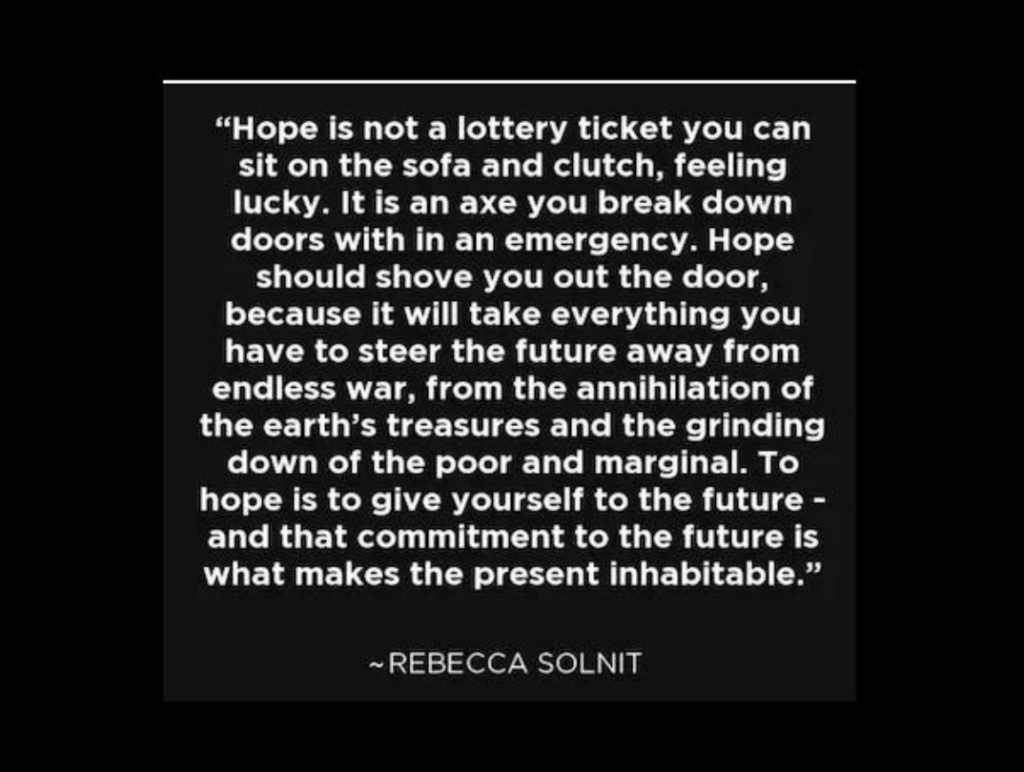
Rebecca Solnit: “Hope locates itself in the premises that we don’t know what will happen and that in the spaciousness of uncertainty is room to act . . . Hope is an embrace of the unknown and the unknowable, an alternative to the certainty of both optimists and pessimists. Optimists think it will all be fine without our involvement; pessimists take the opposite position; both excuse themselves from acting.”

George Hrbek: “I always go back to the absolute necessity of community. When you’re part of a hope movement, if you’re talking about how do I keep up my spirits, and how does hope stay alive in my own life, it doesn’t come by me operating singularly. It’s within community, together with other people who also hope, and who provide encouragement to each other.”

Lynn Burnett: “If we pause to think about the Black Freedom Struggle saying, ‘making a way out of no way’, we can see that it expresses a teaching about hope: a teaching that possibility — ‘making a way’ — exists even within seemingly impossible situations: ‘out of no way.’ The phrase clearly acknowledges harsh realities, while expressing a commitment to keeping the spirit and the struggle alive. Hope is a path, carved between naïve optimism and pessimistic defeatism.”

Vaclav Havel: “The kind of hope I often think about (especially in situations that are particularly hopeless, such as prison) I understand above all as a state of mind, not a state of the world. Either we have hope with-in us or we don’t; it is a dimension of the soul; it’s not essentially dependent on some particular observation of the world or estimate of the situation. Hope is not prognostication. It is an orientation of the spirit, an orientation of the heart; it transcends the world that is immediately experienced, and is anchored somewhere beyond its horizons. Hope, in this deep and powerful sense, is not the same as joy that things are going well, or willingness to invest in enterprises that are obviously headed for early success, but, rather, an ability to work for something because it is good, not just because it stands a chance to succeed.”

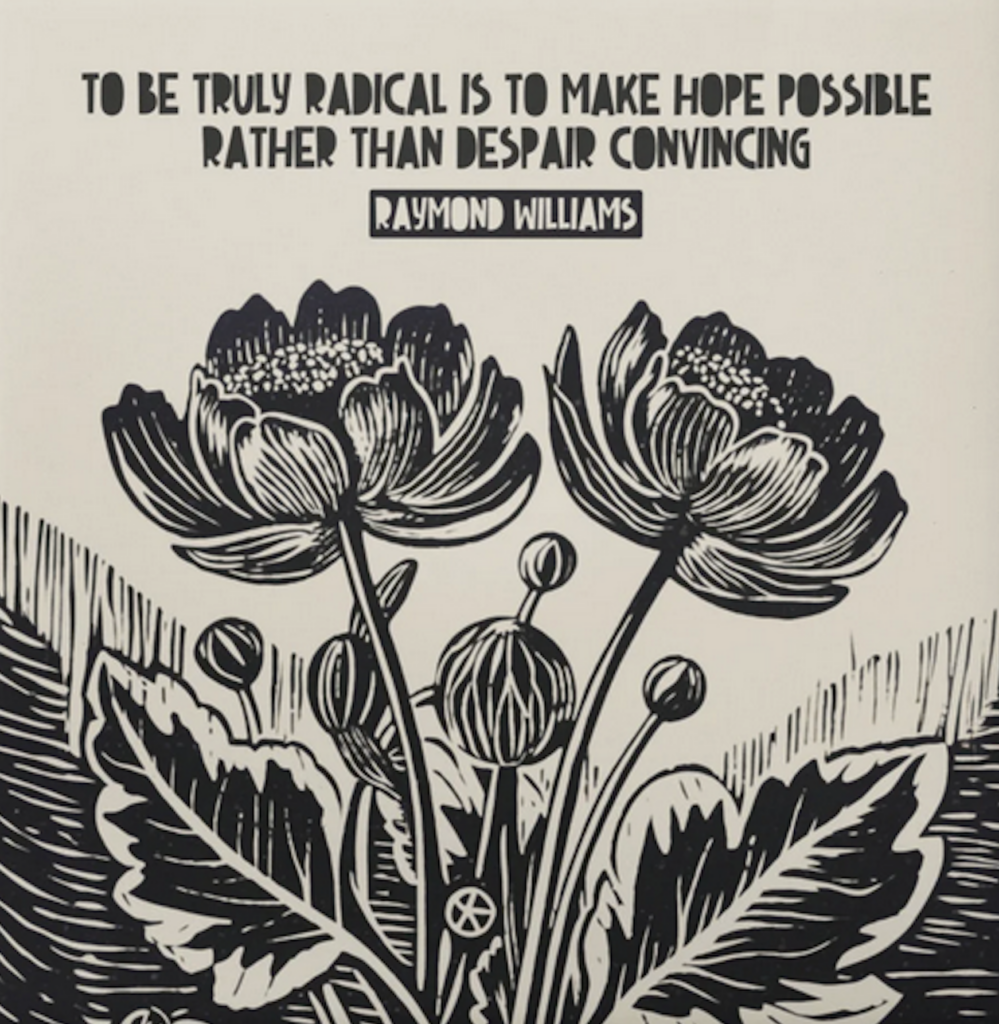
Image: Raymond Williams, on Etsy.

Books

Allan Aubrey Boesak: Dare We Speak of Hope? Searching for a Language of Life in Faith and Politics.

Paul Rogat Loeb: The Impossible Will Take a Little While: A Citizen’s Guide to Hope in a Time of Fear.

Joanna Macy & Chris Johnstone: Active Hope: How to Face the Mess We’re in with Unexpected Resilience and Creative Power.

Rebecca Solnit: Hope in the Dark: Untold Histories, Wild Possibilities.

Krista Tippett: Becoming Wise: An Inquiry into the Mystery and Art of Living.

Articles

Lynn Burnett: In Memoriam for George Hrbek: A Life of Radical Hope.

Joan Halifax: The Hope We Need Now.

Mariame Kaba: Hope Is a Discipline: Mariame Kaba on Dismantling the Carceral State.

Sigal Samuel: Why Cornel West is hopeful (but not optimistic): A conversation about Black liberation theology, existentialism, and other philosophies that can help us through these times.

Rebecca Solnit: ‘Hope is a​n embrace of the unknown​’: Rebecca Solnit on living in dark times.

Jessica Stillman: Want to Be More Successful? Psychology Says You Should Stop Trying to Be Optimistic and Be Hopeful Instead: No, hope and optimism are not the same thing. And research is clear that for positive life outcomes, hope is most important.

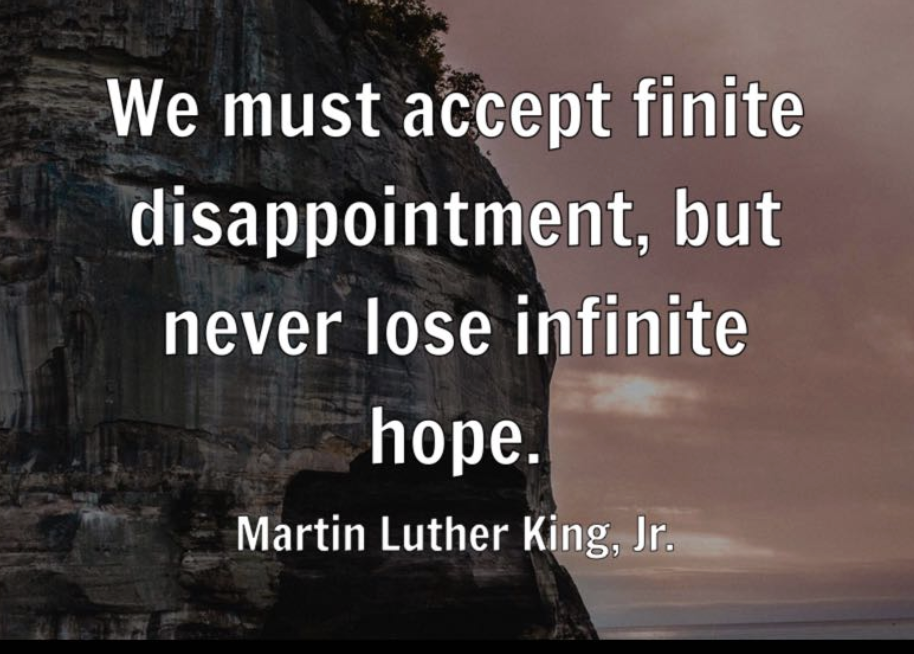
Kendra Thomas: Hope is not the same as optimism, a psychologist explains − just look at MLK’s example.

Krista Tippett:

Podcasts

Lady Don’t Take No: with Alicia Garza. Linda Burnham Knows Where the Hope is.

On Being: The Future of Hope Series.

Rebecca Solnit:

Books For Activists and Organizers

Saul D. Alinsky: Rules for Radicals: A Practical Primer for Realistic Radicals.

Becky Bond & Zack Exley: Rules for Revolutionaries: How Big Organizing Can Change Everything.

Andrew Boyd & Dave Oswald Mitchell: Beautiful Trouble: A Toolbox for Revolution.

Linda Burnham, Max Elbaum, & Maria Poblet: Power Concedes Nothing: How Grassroots Organizing Wins Elections.

Erica Chenoweth & Maria Stephan: Why Civil Resistance Works: The Strategic Logic of Nonviolent Conflict.

Mark Engler & Paul Engler: This Is an Uprising: How Nonviolent Revolt Is Shaping the Twenty-First Century.

Kazu Haga: Healing Resistance: A Radically Different Response to Harm.

Myles Horton: The Long Haul.

Leah Hunt-Hendrix & Astra Taylor: Solidarity: The Past, Present, and Future of a World-Changing Idea.

L.A. Kauffman:

George Lakey: How We Win: A Guide to Nonviolent Direct Action Campaigning.

James Lawson: Revolutionary Nonviolence: Organizing for Freedom.

Ian Haney López: Merge Left: Fusing Race and Class, Winning Elections, and Saving America.

Eric Mann: Playbook for Progressives: 16 Qualities of the Successful Organizer.

Jane F. McAlevey: No Shortcuts: Organizing for Power in the New Gilded Age.

Aric McBay:

Matthew Miller & Srdja Popovic: Blueprint for Revolution: How to Use Rice Pudding, Lego Men, and Other Nonviolent Techniques to Galvanize Communities, Overthrow Dictators, or Simply Change the World.

Mike Miller: Community Organizing: A Brief Introduction.

Mike Miller & Aaron Schutz: People Power: The Community Organizing Tradition of Saul Alinsky.

Charles M. Payne: I’ve Got the Light of Freedom: The Organizing Tradition and the Mississippi Freedom Struggle.

Barbara Ransby: Ella Baker And The Black Freedom Movement: A Radical Democratic Vision.

Jonathan Smucker: Hegemony How-To: A Roadmap for Radicals.

Zeynep Tufekci: Twitter and Tear Gas: The Power and Fragility of Networked Protest.

Laura Visser-Maessen: Robert Parris Moses: A Life in Civil Rights and Leadership at the Grassroots.