Connie M. Razza: “…we define mutual aid as an all-encompassing term for projects that provide direct and collective aid to people as a form of solidarity, often with an expressly political framework and the goal of long-term social change.”
Image from the SNCC Legacy Project, of SNCC staff singing freedom songs. (Singing is a powerful way to build strong community bonds.) Atlanta, 1963.
Although these books are not directly about activism or organizing, effective activism and organizing rests on the strength of the bonds we build together. A strong sense of community and connection supports the energy and emotional health of organizers, prevents burnout, keeps people invested over the long haul, and contributes greatly to growth, meaningful learning, and effective action.
Cornel West: “Optimism for me has never been an option. Because there’s too much suffering in the world.” Hope, on the other hand, is “an act of courage and imagination.”
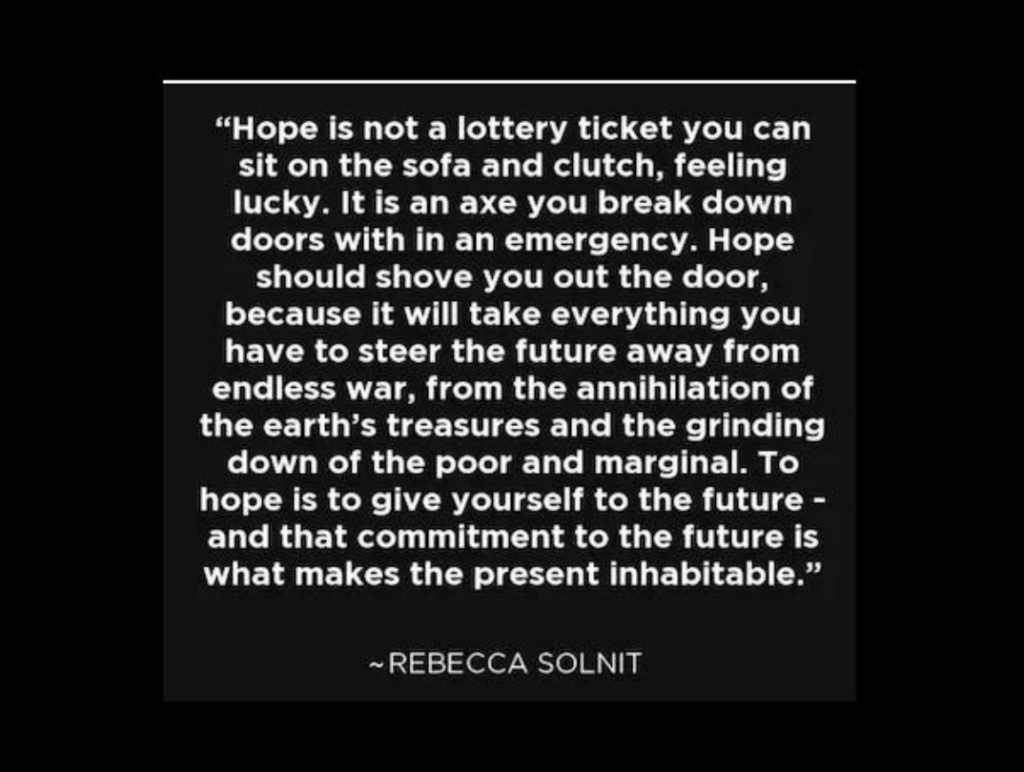
Rebecca Solnit: “Hope locates itself in the premises that we don’t know what will happen and that in the spaciousness of uncertainty is room to act . . . Hope is an embrace of the unknown and the unknowable, an alternative to the certainty of both optimists and pessimists. Optimists think it will all be fine without our involvement; pessimists take the opposite position; both excuse themselves from acting.”
George Hrbek: “I always go back to the absolute necessity of community. When you’re part of a hope movement, if you’re talking about how do I keep up my spirits, and how does hope stay alive in my own life, it doesn’t come by me operating singularly. It’s within community, together with other people who also hope, and who provide encouragement to each other.”
Lynn Burnett: “If we pause to think about the Black Freedom Struggle saying, ‘making a way out of no way’, we can see that it expresses a teaching about hope: a teaching that possibility — ‘making a way’ — exists even within seemingly impossible situations: ‘out of no way.’ The phrase clearly acknowledges harsh realities, while expressing a commitment to keeping the spirit and the struggle alive. Hope is a path, carved between naïve optimism and pessimistic defeatism.”
Vaclav Havel: “The kind of hope I often think about (especially in situations that are particularly hopeless, such as prison) I understand above all as a state of mind, not a state of the world. Either we have hope with-in us or we don’t; it is a dimension of the soul; it’s not essentially dependent on some particular observation of the world or estimate of the situation. Hope is not prognostication. It is an orientation of the spirit, an orientation of the heart; it transcends the world that is immediately experienced, and is anchored somewhere beyond its horizons. Hope, in this deep and powerful sense, is not the same as joy that things are going well, or willingness to invest in enterprises that are obviously headed for early success, but, rather, an ability to work for something because it is good, not just because it stands a chance to succeed.”
Support the grassroots get-out-the-vote organizations that do this work best, with the Movement Voter Project. Host an MVP event to get your networks involved, too.
Want to get out into swing states and knock on doors? Check out Seed the Vote.
Join Swing Left to help win strategic legislative seats that will prevent future gerrymandering.
Want to learn about the history of voting rights and voter suppression? Here’s a reading list: Ari Berman and Carol Anderson’s books are especially good to start with.